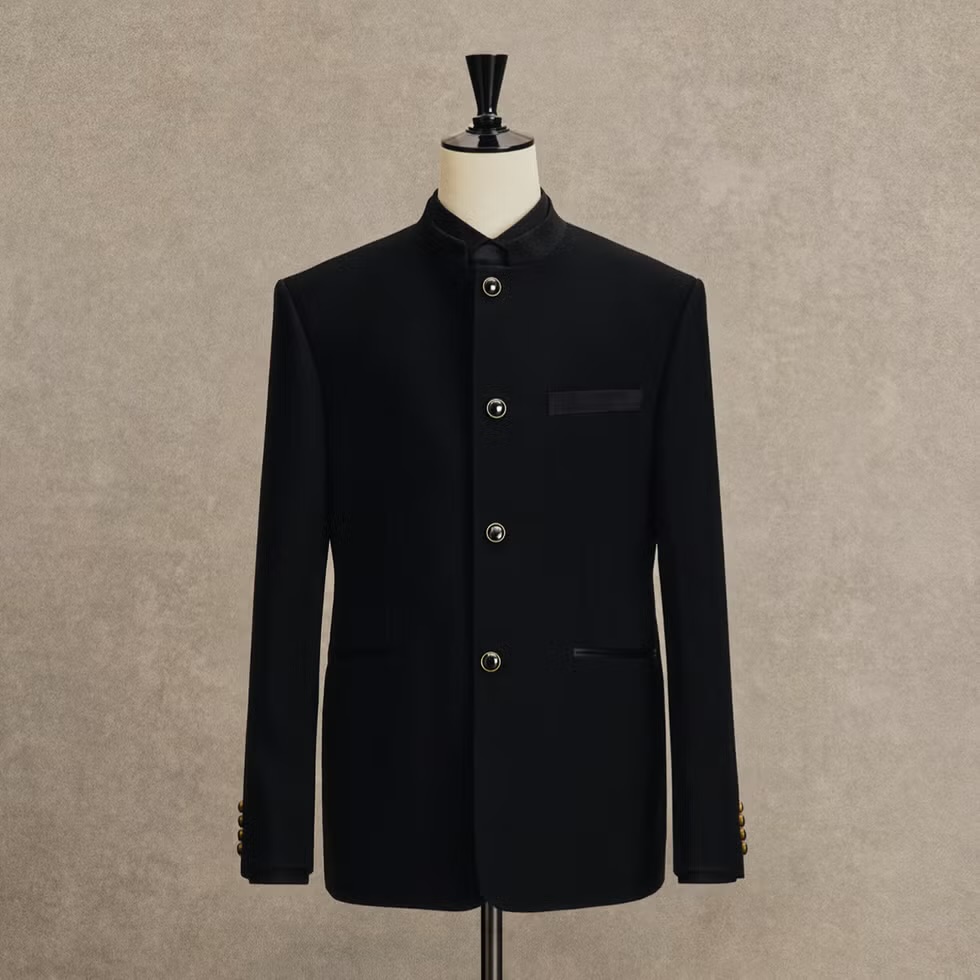
When the world thinks of fashion, it thinks of Paris. The runways, the houses, the mythology of French taste, all of it carefully constructed and endlessly celebrated. India's contributions to the global wardrobe, however, exist in a quieter register. The bandhgala, block prints, paisley, cashmere, even the word pyjama traces back to the subcontinent. Borrowed extensively, credited rarely. When Michael B. Jordan walked onto the Oscar stage on March 15, 2026, and accepted Best Actor in what every publication called a Nehru jacket, a Mandarin collar, a Chinese-inspired silhouette, the vocabulary was familiar. The origin was not.
The garment was not a Chinese import. It was not a modern invention. It was a bandhgala, a silhouette with a lineage that predates Nehru by centuries and extends back to the royal courts of Jodhpur, Rajasthan. The Maharaja of Jodhpur fused the traditional angarkha with structured colonial tailoring to create the fitted, stand-collar jacket now worn at weddings, state dinners, and apparently, Oscar ceremonies. The Jodhpur polo team brought it to London in the 1930s. That is how the West first encountered it. The credit, as usual, did not follow.
"Borrowed extensively, credited rarely."
India's contributions to global dress have long been absorbed without attribution. Paisley originates in Kashmir, not Scotland. Cashmere is named after the same region yet marketed as a European luxury. Block prints carry centuries of Indian craft tradition and are sold as bohemian aesthetic. Pyjamas began as Indian everyday attire. The pattern is consistent. The garment travels. The origin stays behind.
Fashion capitals are defined as Paris, Milan, New York. India, despite centuries of textile innovation, is positioned as supplier rather than source. Its muslin, indigo, and chintz shaped European industries long before the rise of couture houses. Yet the subcontinent rarely appears in the conversation as a fashion authority, only as an influence, an inspiration, a mood board.
Language is where this happens most quietly. To call a bandhgala a Nehru jacket reduces four centuries of royal tailoring to a mid-20th century political association. To call it a Mandarin collar collapses entirely distinct Asian traditions into a single vague category. Neither term is neutral. Both redirect the credit.
"To call a bandhgala a Nehru jacket reduces four centuries of royal tailoring to a mid-20th century political association."
On March 15, 2026, one of Hollywood's most watched men stood on the world's most watched stage in a silhouette that began in the courts of Rajasthan. Every major publication got the look right. Nobody got the name right.
The bandhgala was never a borrowed silhouette. It was the original. Fashion kept renaming it. It never stopped being Indian.