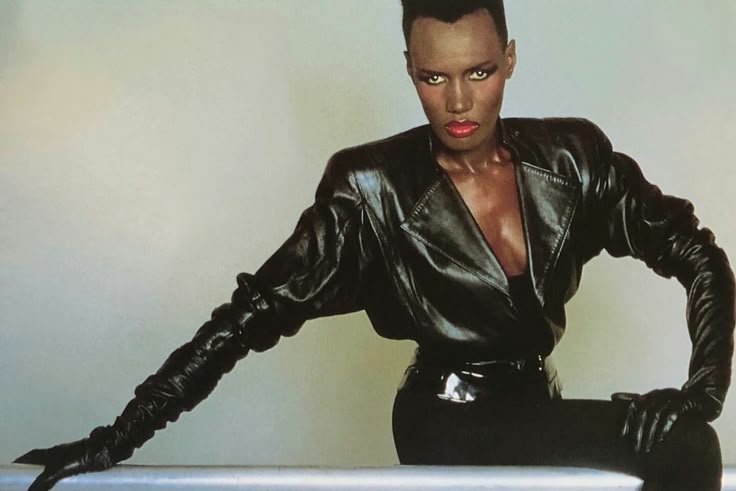
The James Bond franchise has always known exactly what it wants from its women. Since Dr. No in 1962, the visual language was consistent: decorative, compliant, dressed to signal availability. The Bond girl was a fixture of the film's architecture, present to reflect the protagonist's world rather than inhabit her own. The clothes reinforced this. Garments chosen to be looked at, not to say anything.
For over two decades, that template held without serious challenge. Then came A View to a Kill in 1985, and with it, May Day.
May Day was a villain's enforcer. Grace Jones played her, and in doing so became the first Bond girl in the franchise's history to have any real input over her own costume. She brought Alaïa in herself, worked alongside costume designer Emma Porteous, and chose every fabric. She later described approaching the wardrobe like a cartoon, referencing Disney colours because the Bond world seemed that unreal to her. The clothes reflected that. They were made outside the franchise's logic, and it showed.
What arrived on screen reflected exactly that. Patent leather. Hooded gowns. Sharp pinstripe suits. Body-conscious dresses that had nothing to do with the passive femininity the series had spent twenty years costuming. The clothes did not soften May Day or make her approachable.
"This was not incidental. It was Alaïa."
Azzedine Alaïa was a Tunisian-born couturier who built one of the more distinct design philosophies of the 1980s. He refused to show on the official Paris calendar, held his own presentations on his own schedule, and had little interest in fashion's institutional timeline. His central preoccupation was the body, not as spectacle but as structure. His second skin approach was built on the idea that a garment should move with a woman rather than contain her. He worked with stretch fabrics, with precision cutting, with the architecture of fit. The result was clothing that made the wearer more present rather than more ornamental.
That distinction is subtle on a runway. On a Bond set, surrounded by twenty years of visual grammar pointing in the opposite direction, it registered differently.
May Day did not dress like the Bond girls who came before her because the clothes came from a completely different set of values. The garments Grace Jones wore in that film belonged to her character in the truest sense. They suggested authority rather than availability, made the body the one holding power in the frame. This was not something the Bond franchise had particularly planned for.
"When she brought him into the Bond production, she was not hiring a costume designer. She was bringing her own visual language into a space that had never encountered it."
Grace Jones and Alaïa had been close friends since the early 1980s. She was among his most consistent muses, not because he dressed her for visibility but because they shared a sensibility: a refusal to follow the industry's terms, an understanding that a woman's presence should be defined by herself. When she brought him into the Bond production, she was not hiring a costume designer. She was bringing her own visual language into a space that had never encountered it.
The result was recognised beyond the film. Alaïa won Best Creator at the Fashion Oscars in 1985. The franchise got more than it had asked for and likely more than it fully understood at the time.
What makes this worth thinking about is that none of it was designed as a statement. Alaïa dressed his friend in clothes that were true to who she was. The contrast with everything around it was a byproduct of that, not the intention. The subversion was quiet, almost incidental, which is perhaps why it held.
The dress did not serve the film. The film, for once, served the dress.