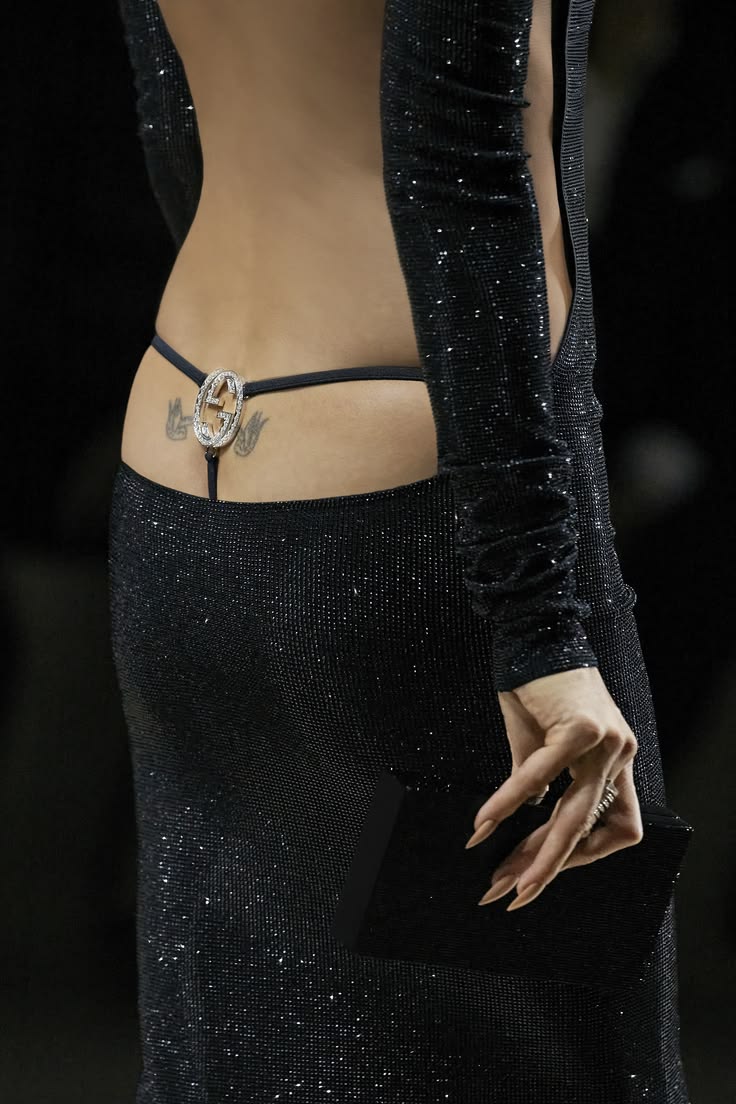
"Zara with a Gucci tag." "Where's the vision?" The verdict was in before the week was over. Demna's first full collection for Gucci: a disappointment. Safe. Derivative. Beneath him.
I thought it was great.
Not in a contrarian way. Not in a "well actually" way. Genuinely, straightforwardly great. And I think the pile-on says more about how fashion audiences have been trained to consume newness than it does about what actually happened in that room at Palazzo delle Scintille.
Demna spent a year in the Gucci archive, understood what made the house iconic at its peak, and built a collection that honoured that with full intention. The skinny silhouettes, the body-consciousness, the darkened room with a single strip of light following the model down the runway. These weren't creative accidents or laziness. They were direct citations of Tom Ford's celebrated Fall 1995, 1996, and Spring 1997 collections. The era that made Gucci Gucci, not historically, but culturally. The era people still reference when they want to say something was genuinely, uncomplicatedly desirable.
And the internet called it Zara.
"The spectacle was always in the restraint. Ford's Gucci wasn't celebrated for being loud. It was celebrated for being precise."
The frustrating thing is that the criticism isn't even engaging with what Demna actually did. It's pattern-matching. Tight clothes — cheap. Minimalism — safe. No maximalism — no vision. It treats the absence of spectacle as evidence of failure, when the spectacle was always in the restraint. Ford's Gucci wasn't celebrated for being loud. It was celebrated for being precise. Demna understood that, translated it for 2026, and got penalized for not doing something unrecognizable instead.
There's also something worth naming about the specific quality of the criticism. It has a particular eagerness to it, almost relieved. The complaints slide between "he's copying Tom Ford" and "he didn't bring his Balenciaga energy" without acknowledging that those two things cancel each other out. He can't be faulted for not being original and simultaneously faulted for not replicating his previous identity. But that's where the criticism lives, in the gap between whatever he did and whatever the internet had already decided it wanted.
I think there's something genuinely worth defending about a designer who looks at an archive and says: this is so good, it deserves to be felt again. Not copied, felt. Primavera wasn't a mood board recreation. It was a studied, deliberate act of reverence that still produced 82 coherent, wearable, desirable looks. Kate Moss closing in that backless gown with the diamond GG thong wasn't nostalgia. It was a closing argument. It said: I know what this house is capable of. I know what this body of work meant. And I am not embarrassed to say so.
"Sometimes the most original thing you can do is refuse to pretend the past didn't happen."
Sometimes the most original thing you can do is refuse to pretend the past didn't happen.
The boredom people are describing is, I think, actually discomfort, with simplicity, with a collection that doesn't need to explain itself, with a designer who made something clean in a moment when the industry has been rewarding chaos and concept over cut. Gucci Primavera trusted its own eye. That's rarer than it sounds.
Was it the safest possible debut? Probably. Was it boring? Not even close.