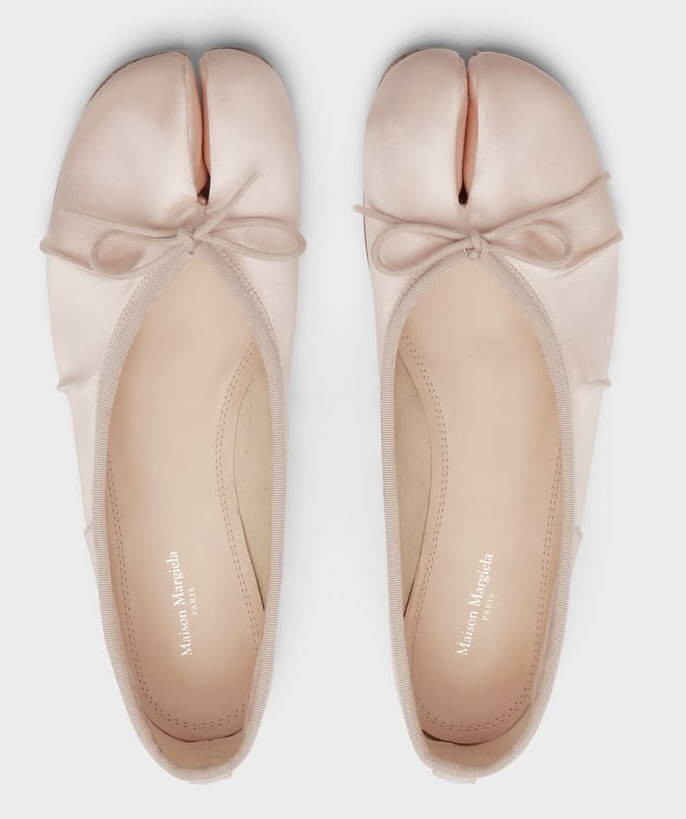
The Tabis are everywhere. But not everybody knows that they were never designed to be a fashion choice everybody applauds. They were designed to be uncomfortable.
In 1988, Margiela held his debut show at the Café de la Gare in Paris. Not a grand venue, a café. The models walked out in split-toe shoes that looked like nothing fashion had sanctioned before. Not elegant. Not elongated. The audience didn't know what to make of it. A critic called it admirable ugliness. Margiela didn't disagree.
The Tabi is not his invention. It originates in 15th century Japan, a split-toe sock built to be worn with thonged sandals. Its history is a study in class mobility. When cotton was scarce, only the wealthy wore them, colours regulated by hierarchy, gold and purple for the elite, blue for commoners. When trade with China opened and cotton became accessible, the Tabi moved down the social ladder. By the 1900s, rubber soles were added and the Jika-Tabi became workwear. Functional. Unglamorous. Worn by people with things to do.
"From aristocrats to commoners to labourers. And then, a Paris runway."
Margiela encountered the Tabi on a trip to Tokyo with the Antwerp Six, a collective of Belgian designers dismantling fashion's conventions at the time. He saw street workers in flat cotton tabi shoes and asked himself one question. Why not put it on a heel? He designed the shoe. Not a single cobbler would make it. The split toe was too wrong, too radical. He made them anyway.
The Tabi wasn't an immediate success. Margiela had so little budget in the early years that he repainted unsold pairs from the previous season and sent them out again. One of fashion's most recognisable silhouettes existed, for years, out of necessity rather than intention.
What Margiela understood, and what the industry hadn't, was that fashion had quietly agreed on what a foot was supposed to look like. Pointed. Elongated. One clean line. The Tabi split it. It asked a question nobody in fashion was asking. Why does a shoe have to flatter? Why does beauty have to be comfortable to look at?
"That question was the entire philosophy of Margiela's work. The Tabi was just the most visible place he put it."
And then, slowly, the rest of the world caught up.
Today the silhouette has expanded into ballet flats, loafers, sneakers, and menswear under John Galliano, who led Maison Margiela from 2014 until 2025. It has been made in leather, PVC, metallics, canvas. It is worn by fashion insiders and university students on their morning commute with equal conviction. It has never stopped being itself.
The full circle is what makes the story worth telling. A design that began with Japanese aristocrats, became workwear, arrived on a Paris runway, got called ugly, got repainted because there was no budget, and then 35 years later became the shoe that defined a generation's relationship with fashion that refuses to apologise for itself.
The Tabi didn't follow culture. Culture kept catching up to the Tabi.
Not every great design announces itself. Some of them make you shift in your seat first. Some of them need the world to grow into them.
The most enduring things in fashion were never meant to be immediately beautiful. They were meant to be honest.